SonicWall SMA1000 Zero-Days: Two Flaws Being Exploited Together — Patch Now
SonicWall has confirmed active exploitation of two SMA1000 vulnerabilities — a maximum-severity SSRF and a post-authentication command injection flaw — being chained together in real attacks. CISA's patch deadline is July 17. Here's what to do today.
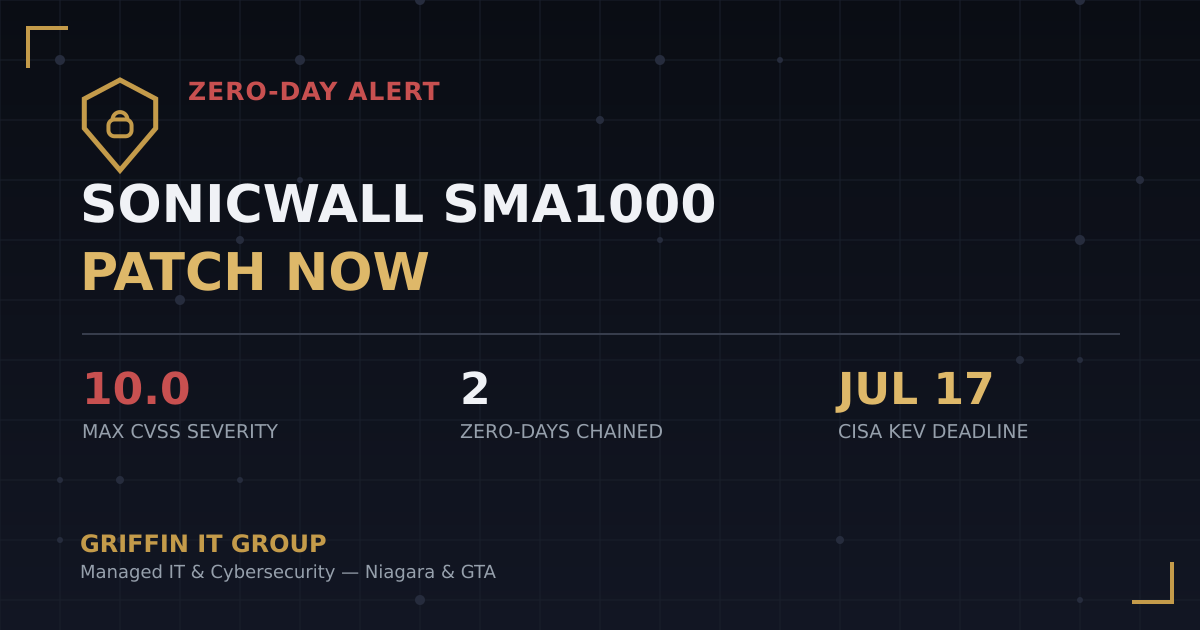
SonicWall has confirmed that two vulnerabilities in its SMA1000 series appliances are being actively exploited together in real-world attacks. One is about as bad as vulnerabilities get — a maximum-severity, unauthenticated flaw that lets an attacker reach into the appliance from the outside — and the second lets that same attacker turn access into arbitrary command execution once inside. CISA has already added both to its Known Exploited Vulnerabilities catalog, with a July 17 remediation deadline for federal agencies. If you run SMA1000 appliances for remote access, that deadline is worth treating as your own.
What's affected
The SMA1000 series is SonicWall's secure remote-access platform — the appliance many mid-market organizations use to let employees connect into the corporate network from home, client sites, or the road. That makes it a high-value target: compromise the VPN gateway and you potentially get a foothold on everything behind it. The vulnerable versions are 6210, 7210, and 8200v. SonicWall has released hotfix builds 12.4.3-03453 and 12.5.0-02835 to address both flaws, and is urging customers to update immediately rather than waiting for a scheduled maintenance window.
Two flaws, used together
CVE-2026-15409 — unauthenticated SSRF (CVSS 10.0)
This is a server-side request forgery vulnerability in the SMA1000's Appliance Work Place interface. It requires no authentication at all: a remote attacker can force the appliance to make requests to locations it shouldn't be reaching, effectively using the appliance itself as a relay into parts of the network — or the appliance's own internal services — that should be off-limits from the outside. A CVSS score of 10.0 is the maximum possible; SonicWall and CISA are both treating it as critical.
CVE-2026-15410 — post-authentication code injection (CVSS 7.2)
The second flaw sits in the SMA1000's Management Console and requires some level of authenticated access to trigger. Once an attacker has that access, a code injection bug lets them execute arbitrary operating system commands on the appliance. On its own, this vulnerability is less alarming — you'd need valid credentials or an existing session first. That's exactly what makes the pairing dangerous.
Why the combination matters
In the attacks SonicWall has observed, the two bugs aren't being used in isolation — they're being chained. The unauthenticated SSRF flaw gives an attacker a way to reach the Management Console without ever needing a password, and the code injection flaw then turns that access into full command execution on the device. Two vulnerabilities that individually require different preconditions become, together, a complete unauthenticated-to-root path. This is a pattern worth remembering beyond this specific incident: a "medium risk, requires authentication" finding on its own security scan is only as safe as the assumption that nothing else on the network can hand an attacker that authentication for free.
Why this isn't just a SonicWall problem
Remote-access VPN appliances have been a favored entry point for attackers for several years now, precisely because they sit at the network edge by design and are often patched less aggressively than internal servers — nobody wants to risk breaking remote access for the whole company during business hours. That operational caution is understandable, but it's also exactly the gap attackers are counting on.
SonicWall isn't alone here, either. Edge devices from multiple vendors have landed in CISA's KEV catalog repeatedly over the past few years, and the pattern is consistent: these appliances are internet-facing by design, run complex web-based management interfaces, and are frequently excluded from the same vulnerability scanning and patch automation that covers the rest of the estate. If your organization treats edge appliances as "set it and forget it" infrastructure rather than something on a regular patch cadence, this is a good moment to revisit that assumption.
What we recommend
- Check your SMA1000 firmware version today. If you're not already on 12.4.3-03453 or 12.5.0-02835, patching is not optional — treat it with the same urgency as a confirmed active breach, because the exploitation is already happening in the wild.
- Restrict access to the Management Console to internal or VPN-only networks if it isn't already — it should never need to be reachable directly from the public internet.
- Review SMA1000 access and authentication logs for anything unusual since early July, particularly unexpected Management Console logins, new admin accounts, or configuration changes you didn't make.
- If you're a Griffin IT Group managed client, this appliance is already on our priority patch list this cycle — reach out if you want confirmation of where your specific device stands.
- More broadly: build a standing patch cadence for edge devices — firewalls, VPN concentrators, remote-access gateways — separate from your regular desktop and server patching. These devices deserve faster turnaround, not slower, given how often they're the first thing attackers touch.
CISA's July 17 deadline applies formally to federal agencies, but it's a reasonable benchmark for any organization: if you haven't patched by then, assume you're operating on borrowed time rather than borrowed safety. Griffin IT Group clients on our managed security program are being proactively verified against this advisory — if you're not sure where your organization stands, get in touch and we'll check.